Saturday, September 8, 2018

So much to see. . .

Well they say every picture tells a story.

As does this one. . .

Three women, all in long dresses.
The youngest looks dressed for school or something.
The one on the steps looks dressed for work.

The one almost off camera to the left has an even longer dress on, and maybe a little more dressy.


The shingled roof is well done. Shingles even and neat and in good repair.

The fire place built of probably nearby rough stone. Not a neat stone finish like a mason would do. More like it was built by the cabin builder.

No windows can be seen, but that doesn't mean there are none on the other side.

No chinking between the logs. Just boards covering some of the gaps. What ever was out side could come in. Small critters, the weather.

There is an upstairs. Probably a sleeping area.

The logs are close to the ground which means they won't last long. Maybe one or two have already failed because you can see some vertical boards covering an opening on the right front.

A home or a school?

While about the same size, this photo says different things.

Glass in the windows and curtains.

The logs are up off of the ground and well protected. Probably a warmer climate otherwise the floor would be really cold in the winter with in being so open.

With the open window on top of the side, it looks like it should have an upstairs, but no floor joists are visible from the outside. A more 'modern' joist system could have been added later. Just ventilation?

You can see the first floor joists under the windows. Flat hewn logs with the hewn sides up.

A room or two has been added on the back. A kitchen or bedrooms?

Two kids, in overalls. Probably a farm, maybe even sharecroppers.

Looks like another log building in the back ground.

A much neater house.

While in the top photo you can't imaging spending any more time inside the you absolutely needed to.
In the second photo you can imagine the inside being a little more cozy.

Monday, September 3, 2018

Under 'Log Cabins I have known' and More done on the Adirondack Shelter

Usually in the summer I don't get to much done on the cabins. The heat and bugs make it just a little too unpleasant to work out there. I do basic up keep and yard work and just generally keep an eye on the place.

But. . .

I did get to spend a week up in Maine in August and brought back some pictures of a writers cabin up there that I have posted about before. Hopefully a couple views I have not posted before.

This cabin belonged to Edmund Ware Smith.

Here is one previous post about him and the cabin.

And here are more recent photos.

 This is the first view you get when you walk up to it from the direction of where I worked.


 This view is close to the view in the old photo from the newspaper in the earlier post.

 I don't know why they have never rebuilt the porch on the lake side, but it sure would look nice if they did.


This past Saturday I got a chance to do more chinking prep out at the cabin on the Adirondack shelter.

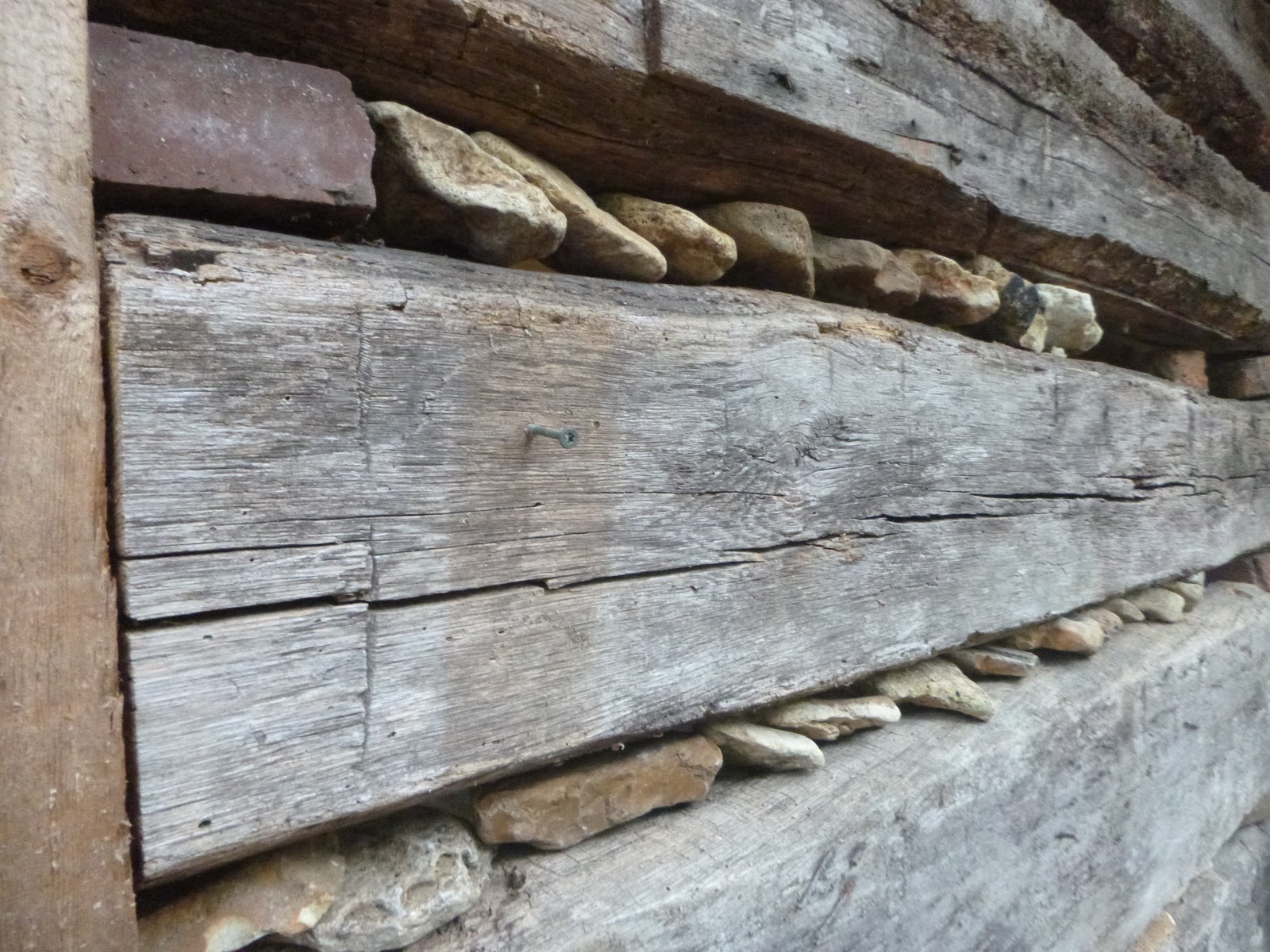
Placing stones between the logs to hold the chinking or dabbing.

 This method of applying stones between the logs to hold the chinking or dabbing is a method that would or could have been used on early cabins. I have found it on several I have worked on.

I like it because not only is it a natural material, it also helps support the logs and the cement I use for chinking really binds to it.

Also, better than the modern wire and nail method, which is strong and secure, the stones between the logs makes it easier, if it ever gets moved again, to take down and reuse.
 Like fallen dominos.
 I got the two sides done and just need to return to finish the back three rows.
 Closer look.
From the inside.


This big guy greeted me when I arrived.

Monday, July 30, 2018

B2R by the fire. "A Place in the Woods", Helen Hoover.

 "A Place in the Woods" is about two people who finally took a chance on making a dream come true before their chance slipped away.

Not written by an individual or couple who were use to a remote life style, it follows their first year or so coming to terms with their choice and learning to love it.

Back in the 60's Helen's books helped inspire some of the back to nature movement.

Much of their involvement with some of their animal friends would find criticism with environmentalist, but has to be taken in context.

An easy, fun read that gives you lots of time to think who you would handle the same situations.

She doesn't mind admitting that in the beginning they were in way over their heads.
Helen Hoover

Her husband illustrated the books.

And they had a log cabin!

Friday, June 22, 2018

Cool weather got me started . . .

Daughter and I headed out to the cabin today. With a slight drizzle in the forecast for most of the day, we headed out with no firm plans.
At one point we decided to go for a drive down one of my favorite eastern Missouri drives. Lots of creek crossing and a place where I had gotten stones from before to place between the logs to hold the chinking.

When we got back to the cabin with our bucket load of rocks we practiced placing some of the stones to see how many more we would need.

 If you wedge them in tight they not only give the chinking something to hold onto, but also help support the span of logs.


 Helper.
Two Home Depot orange buckets of rocks easily did three rows of logs (only two are done in this photo).
So that means it won't take many more rock trips.


Here is a picture of the Pitt's building where I explained the method.

I had left these two rows un-chinked so people could see the method.

Wednesday, June 20, 2018

B2R by the Fire - by Conrad E. Meinecke - "Your Cabin in the Woods"

 You are not going to learn a lot from this book. I don't think it was ever suppose to be a manual for 'How to build your Cabin'. I think it was suppose to be more for inspiration to get you started.

It was originally printed in 1947 and probably got lots of guys dreaming. Many probably kept this on their bed-stand so they could dream about their project a night.

It does however give lots of great ideas and I just love the illustrations.

These are the kind of books I loved as a child; ones that made you dream.

And I have always believed illustrations and art-work are better for dreaming than photos.

Conrad comfortably lays out how to go about getting started on your project, but it is not directed specifically to building a log cabin.
But his thoughts are worth taking in.
Like I said, I just love the illustrations and will proudly put this book on my log cabin bookshelf.

The book is available at most online booksellers.


The Illustrations are by Victor Aures.


The Patent for Lincoln Logs


Saturday, June 9, 2018

B2R by the fire (or if you live in Missouri, A.C.) The Log Cabin, an Illustrated History.

If you want to read a book that makes you feel warm and fuzzy about Log Cabins and that will inspire you to find or build your own,  this would not be a good book to start with.

And, I think the title is a little misleading.

The book isn't so much a history of the log cabin as much as a shattering of myth and romance built around our cultures love of the log cabin.

The book is very full of interesting facts, and does cover a little about the introduction of log cabin to the
American landscape.

But it covers much more about what the log cabin is not and how, it the authors opinion, the log cabin is become part of the American Dream and cultural landscape. And how much of that is misleading.

While the illustration do not usually reflect something that is being discussed on the page they are plentiful and interesting.

Andrew also covers many of the myths that surround many of the famous log cabins of our leading politicians. Debunking much of what was believed by the public for many years.

The book is as much a study of society as it is a study of the log cabin.

While I really enjoyed the book (and do recommend it) I think in some off-handed way it neglects a bit about all that is good about the buildings.

The log cabin represents much that is good about our society, as well as much that was bad.

The author at one point almost equates the log cabin to the rape of our American Wilderness.

If you have worked around old log buildings for a while you will have realized much of what is discussed in the book, but you will get some validation for what you have learned.

I don't get the feeling the book was written by someone who loves log buildings (I hope I am wrong).

But if you are going to study the history of log buildings this book should be on your bookshelf.