Usually in the summer I don't get to much done on the cabins. The heat and bugs make it just a little too unpleasant to work out there. I do basic up keep and yard work and just generally keep an eye on the place.
But. . .
I did get to spend a week up in Maine in August and brought back some pictures of a writers cabin up there that I have posted about before. Hopefully a couple views I have not posted before.
This cabin belonged to Edmund Ware Smith.
Here is one previous post about him and the cabin.
And here are more recent photos.
This is the first view you get when you walk up to it from the direction of where I worked.
This view is close to the view in the old photo from the newspaper in the earlier post.
I don't know why they have never rebuilt the porch on the lake side, but it sure would look nice if they did.
This past Saturday I got a chance to do more chinking prep out at the cabin on the Adirondack shelter.
Placing stones between the logs to hold the chinking or dabbing.
This method of applying stones between the logs to hold the chinking or dabbing is a method that would or could have been used on early cabins. I have found it on several I have worked on.
I like it because not only is it a natural material, it also helps support the logs and the cement I use for chinking really binds to it.
Also, better than the modern wire and nail method, which is strong and secure, the stones between the logs makes it easier, if it ever gets moved again, to take down and reuse.
Like fallen dominos.
I got the two sides done and just need to return to finish the back three rows.
Closer look.
From the inside.
This big guy greeted me when I arrived.
Showing posts with label Maine. Show all posts
Monday, September 3, 2018
Thursday, March 15, 2018
Yep, still scanning old slides and photos. . . .
. . . and got to return to another cabin from my past. Once again we go to Maine.
Under 'Log Cabins I have known' I wrote about this cabin in Maine, near Baxter State Park.
The Grand Lake Matagamon cabin of Edmund Ware Smith. (Don't forget to check out his books.)
Scanning and sorting I came across a few more from the time I got to visit the place.
This is the lake side of the cabin.
The opposite side from the view above.
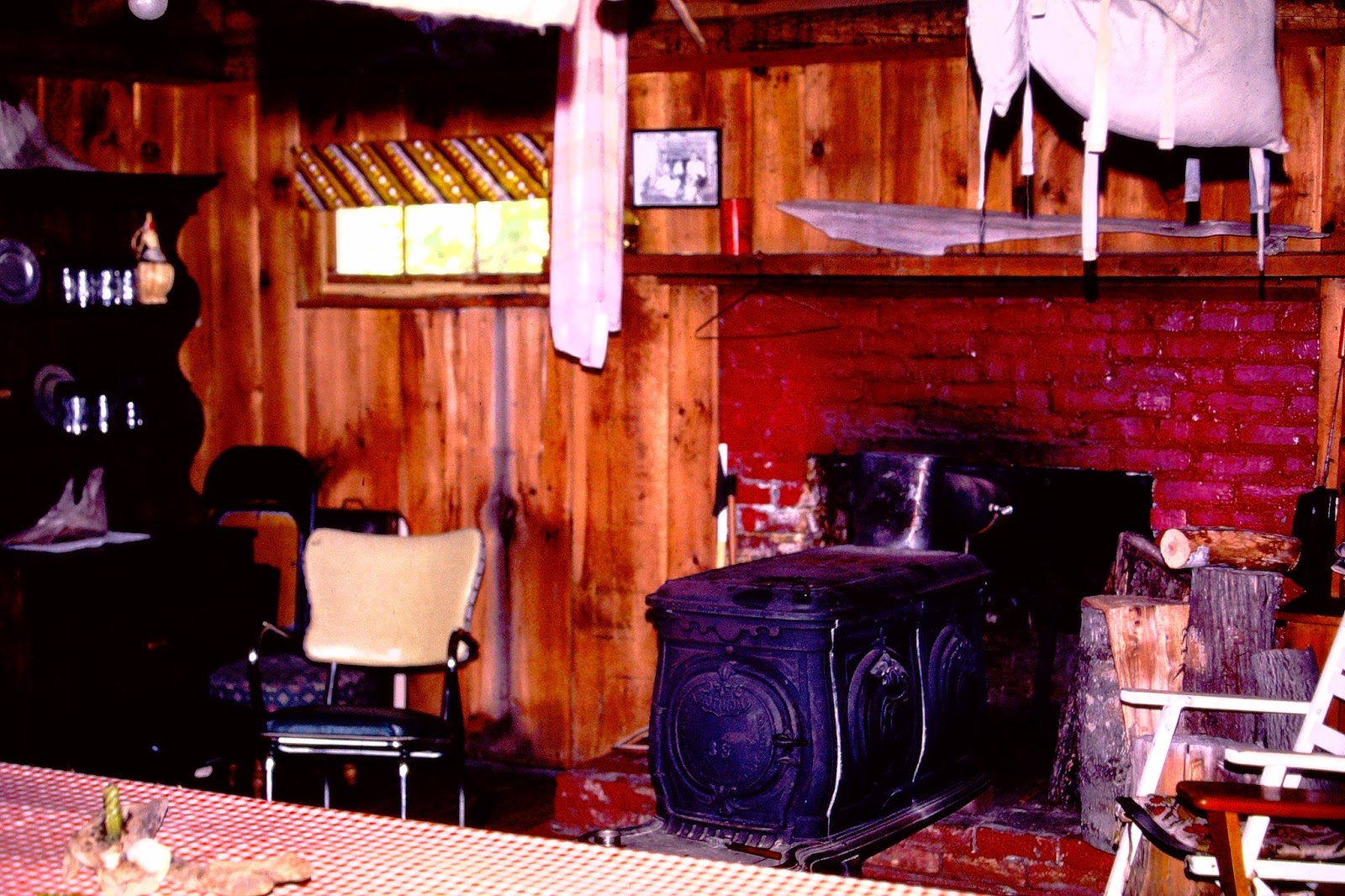
Kitchen, every thing cleaned up and stacked to keep mice away.
Stove.
I didn't take many pictures inside.
I think I felt I was intruding. Although I was there with permission, I guess I felt I shouldn't take too many inside.
Wife walking outside when we visited a few years ago. We did not get to go inside on this trip.
In the above mentioned post I wrote about his friends who would visit and they called themselves 'Jakes Rangers' after artist, who was one of them, Maurice 'Jake' Day.
In the field just out of view in the above photo, there were several smaller cabins, log and otherwise.
Each "member" of Jake's Rangers had there own cabin to sleep in using Smiths house as the informal meeting place for there northern adventures.
Here is a picture of Jakes Rangers with Chief Justice Douglas and the caption that the Baxter State Park page had on the photo;
Jake's Rangers" at Roaring Brook, photo taken by Roaring Brook Ranger Ed Werler, date unknown (likely late 1950's,early '60's).
Left to right: Ed Pierce, Jake Day, Bentley Glidden, Justice William O' Douglas, Edmund Ware Smith. Justice Douglas was a wilderness champion and Edmund Ware Smith wrote about "Jake's Rangers" in his much loved books. Jake Day is the Maine artist who created the seal/logo for Baxter State Park.
Labels:
Baxter State Park,
books,
family,
fun stuff,
Maine,
My photos,
Out of state,
trips
Monday, March 5, 2018
A couple more cabins in Baxter State Park, 1979 - but they are still there.
Don't ya just want to sit on that porch and read a book or somethin'?
Okay, this one is not in Baxter, but just across the lake from Baxter.
Me working on a pack basket on the porch of a log cabin, 1977
Okay, this one is not in Baxter, but just across the lake from Baxter.
Me working on a pack basket on the porch of a log cabin, 1977
Sunday, March 4, 2018
I wonder if they are still there?
An old hunting/fishing camp.
During my time working in Maine in 1977, especially during that period when I stayed an extra month and had some time to myself, I would ask some of the long time locals for some good exploration suggestions.
On this one they sent me looking for a waterfall (which I found) where I found these log buildings from an old hunting and fishing camp.
Friday, September 22, 2017
Books to read while sitting around your cabins fire (We will call this B2R from now on)
Cooler weather is slowly approaching here in Missouri. Today is the fall equinox, Sept 22nd.
So my thoughts start roaming towards cooler days and chilly nights when the fires soft glow warms the spaces in the cabin.
Or if you prefer, taking a break outside by the open fire and reading while the sun warms your back.
No matter what image you come up with, this is the time to start bringing out the books suitable for cabin reading. And when it comes right down to it, it probably doesn't really matter what you read, just take the time and do it.
I am going to try to post at least one book a week till spring time, maybe more, that makes me want to be outside as the weather cools. We will see how that goes.
Whether with a cup of tea or hot chocolate, or a glass of wine, lets get comfortable and enjoy.
For my first suggestion I am going to go down very familiar ground and start with one of my favorite outdoor writers, one I have talked about here a few times.
As I have mentioned here many times, in the late 70's I had the chance to work in some of the most beautiful wilderness in the country, the area called Baxter State Park in Maine.
We were given a list of suggested books to explore that dealt a lot with the area I was going to work in.
One of the authors suggested was Edmund Ware Smith. And he was one of the ones I chose to familiarize myself with the area. Mr. Smith over the years wrote for many of the popular outdoor magazines like Ford Times, Outdoor Life, Sports Afield, etc.
I don't remember which of these two was the first I read, but it doesn't matter, I was hooked.
Either will do to start with.
Both tell stories of the areas local fishing and hunting and characters. Many true and many not so true, but still lots of fun.
You can smell the wood smoke and hear the loons as you read along with Mr. Smith.
I wanted a tar paper roof on my first cabin after reading his description of the sound of rain on a tar paper roof.
The call of the loon is exactly like Mr. Smith describes it.
You can see your canoe paddle cutting through the still lake water as you read the stories.
One of my favorites is the tale of a young man taking his father for his last canoe ride.
The father had died while at the hunting camp and the tale is a paddle down memory lane as the son take him back to the boat landing for the last time.
His books were hard to come by for many years, with old copies starting around $75.00.
But now reprints of some of his books are easily available.
It also didn't hurt that I loved the artist who did the illustrations.
I was also lucky in that Mr. Smiths cabin was just a short hike down an old logging road from where I worked.
I was able to see many of the places he would write about, some just down by the lake in front of his cabin.
Some of the people he wrote about still lived nearby and I got to know them pretty well and kept in touch for many years. This really brought the stories to life.
Mr. Smith had been dead for several years before I came to Maine, but his family still owned the property and I was able to visit it a few times, and walked by it many times.
I go back to these stories quite often and enjoy the return to the Maine woods.
I hope you enjoy the visit also.
Tuesday, August 29, 2017
Well I guess we are still on Maine
While going through old slides last night I came across a cabin from Baxter State Park Maine.
We did not stay in this one, but near it in another cabin.
Monday, August 28, 2017
Since we are talking about Maine anyway. . . . .
That same summer I worked in Maine that I mentioned in the last post, on one of my canoe trips I got to stop by an old hunting fishing camp called Nugents Camp on Chamberlain Lake.
It is one of those places the old guides would tell you you had to stop at if you were passing it.
Accessible only by boat or float plane, it was built in 1936.
And it has log cabins.
Way back when I was there, and I would imagine is still the case, the property had no electricity.
Lighting and cooking and water heating was done by propane.
Refrigeration was done by way of an ice barn (log building) built into the hillside.
In the winter they would cut ice blocks out of the lake and store them in this ice barn, covered with saw dust.
I stopped by in July and there was still plenty of ice. Ice ponds and ice barns were a big deal before refrigeration.
This project - Where it all began.
Many years ago I had the privilege of working at an High Adventure Base in Maine. Right on the boundary of Baxter State Park.
Wilderness, lakes, rivers, wildlife and one of the best places to camp anywhere.
I, needless to say, fell in love with the area.
Depending on which way you are going, Baxter State Park is either your finish or your start to the Appalachian Trail.
And one of my favorite places to camp in the park is Katahdin Stream Campground.
Surrounded by trees, right along Katahdin Stream, the campsite is ideally placed for one of the best hikes up Mt. Katahdin.
The entrance has this view of Mt. Katahdin, but the campsites soon take you into the woods.
And way back in about 1978 is the first time I got to experience an Adirondack shelter like the one pictured here at Katahdin Stream campground.
These are ideal for sleeping in and looking out at the woods, and hearing the stream just beyond your picnic table.
If it is a rainy evening, a great place to hang your lantern and read a book.
Up off the ground, nice and dry.
The closeness to others allow for visiting with like minded campers, yet far enough apart to be private.
And usually when I go there are not many people around anyway.
Here in autumn colors.
Although built of much smaller logs than the ones I am using, this is where I got the idea to begin with.
While this campground is not the only one in the park that has these, these are the ones I think about the most.
And a great place to hang things up to dry.
An old post card of Katahdin Stream Campground.
And look, even the ranger station is made out of logs.
I have also stayed in these shelters (below) at South Branch Pond. . .
. . . as well as some at Nesowadnehunk Field, both in Baxter State Park.
(These at South Branch are my second favorite, but much closer to where I worked near the park.)
Although also built of logs, the building style is a little different.
Thursday, August 18, 2016
An interesting find. . . .
I posted this photo a few weeks ago. . .
And have found a few more pictures of what seems to be the same cabin. . .
The windows, and the wood work on the left side seem to prove it is the same.
Now we have a name of the place. . . clic images to see the full size.
And here is a more complete image of the first photo that started all this. . .
So now we know a little about his history.
Maine Log Cabin drawing by Stanley Warren Greene
"Soliloquy in a Woodshed"
He also illustrated several of the works by Edmund Ware Smith who's cabin we talked about here.
Following are a couple of his drawings for E.W. Smiths books.
Subscribe to:
Posts (Atom)