Showing posts with label Out of state. Show all posts
Thursday, May 24, 2018
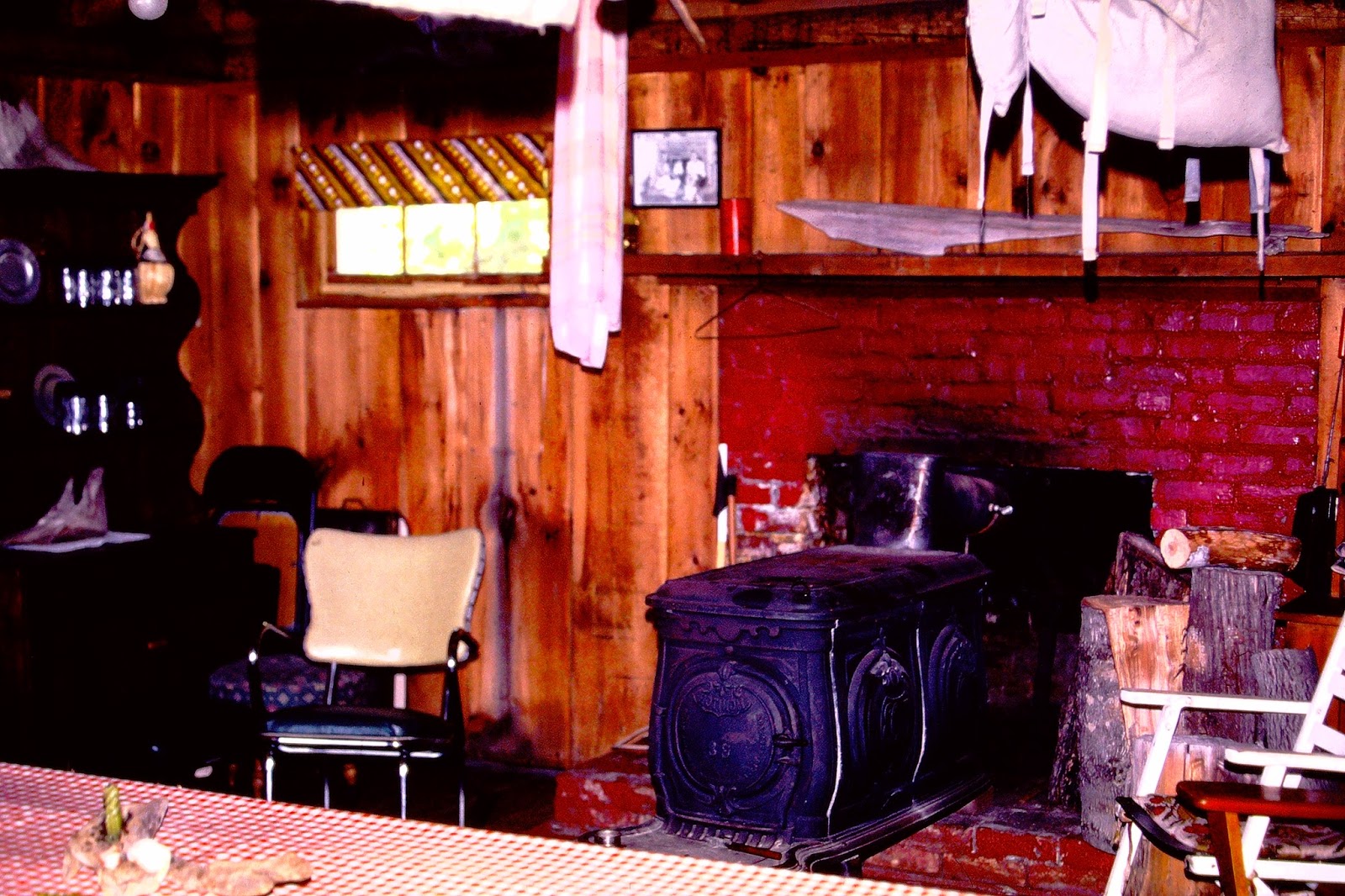
There is so much neat and sad about this photo all at the same time.
It is a neat little place in all senses of the word.
Four rows of shingles to cover each side of the roof.
Log and mud fireplace. Up nice and high of the ground.
But can you imagine the much larger mansion not seen in this photo?
Tuesday, April 24, 2018
B2R by the fire - Eric Sloane's 'Diary of an American Farm Boy'
Both of my blog followers already know I love anything by Eric Sloane.
At one point Eric Sloane came across the diary of an young farm boy named Noah Blake.
He had the diary reprinted and added his wonderful illustrations.
You could imagine a diary being pretty dry reading, but with the illustrations it is quite fun.
I have passed the book on to many young readers.
Below are some photos of a rebuilt Blake's cabin, which a group is trying to preserve, along with some of Eric Sloane's illustrations.
At one point Eric Sloane came across the diary of an young farm boy named Noah Blake.
He had the diary reprinted and added his wonderful illustrations.
You could imagine a diary being pretty dry reading, but with the illustrations it is quite fun.
I have passed the book on to many young readers.
Below are some photos of a rebuilt Blake's cabin, which a group is trying to preserve, along with some of Eric Sloane's illustrations.
Tuesday, March 27, 2018
Eight people . . . . .
B2R by the fire - The Foxfire Books
Mentally, I still believe I am of the age where most things are older than I am.
So, needless to say, I was a little surprised when reading about the Foxfire books that they are a bit younger than I am.
I thought they had been around for much longer.
Anyone who loves hanging around old things (and I guess that includes me now) or old ways knows about the Foxfire book series.
I recently ventured into them again because I wanted to reread the section, which is in the first book, on log cabin building.
As with everything in these books it is fantastic.
While not everything in the books will be of interest to everyone (like how to boil a pig), each book will contain something you will enjoy.
This, book one, had a very large section on cabin building and many of the things that go along with it.
But just as fun was the pieces on the people of Appalachia. Probably the last generation in this country to be totally self sufficient.
The Foxfire book project started out of a need to reach High School students in an otherwise failing system. And like many grassroot startups, it took on a life of its own.
Some day I will have to take a trip to their museum to see the log cabins and such.
Pictured here are a couple from the museum site.
So, needless to say, I was a little surprised when reading about the Foxfire books that they are a bit younger than I am.
I thought they had been around for much longer.
Anyone who loves hanging around old things (and I guess that includes me now) or old ways knows about the Foxfire book series.
I recently ventured into them again because I wanted to reread the section, which is in the first book, on log cabin building.
As with everything in these books it is fantastic.
While not everything in the books will be of interest to everyone (like how to boil a pig), each book will contain something you will enjoy.
This, book one, had a very large section on cabin building and many of the things that go along with it.
But just as fun was the pieces on the people of Appalachia. Probably the last generation in this country to be totally self sufficient.
The Foxfire book project started out of a need to reach High School students in an otherwise failing system. And like many grassroot startups, it took on a life of its own.
Some day I will have to take a trip to their museum to see the log cabins and such.
Pictured here are a couple from the museum site.
Labels:
B2R,
B2R by the fire,
books,
fun stuff,
Historic,
how to,
Others photos,
Out of state,
tools
Thursday, March 15, 2018
Yep, still scanning old slides and photos. . . .
. . . and got to return to another cabin from my past. Once again we go to Maine.
Under 'Log Cabins I have known' I wrote about this cabin in Maine, near Baxter State Park.
The Grand Lake Matagamon cabin of Edmund Ware Smith. (Don't forget to check out his books.)
Scanning and sorting I came across a few more from the time I got to visit the place.
This is the lake side of the cabin.
The opposite side from the view above.
Kitchen, every thing cleaned up and stacked to keep mice away.
Stove.
I didn't take many pictures inside.
I think I felt I was intruding. Although I was there with permission, I guess I felt I shouldn't take too many inside.
Wife walking outside when we visited a few years ago. We did not get to go inside on this trip.
In the above mentioned post I wrote about his friends who would visit and they called themselves 'Jakes Rangers' after artist, who was one of them, Maurice 'Jake' Day.
In the field just out of view in the above photo, there were several smaller cabins, log and otherwise.
Each "member" of Jake's Rangers had there own cabin to sleep in using Smiths house as the informal meeting place for there northern adventures.
Here is a picture of Jakes Rangers with Chief Justice Douglas and the caption that the Baxter State Park page had on the photo;
Jake's Rangers" at Roaring Brook, photo taken by Roaring Brook Ranger Ed Werler, date unknown (likely late 1950's,early '60's).
Left to right: Ed Pierce, Jake Day, Bentley Glidden, Justice William O' Douglas, Edmund Ware Smith. Justice Douglas was a wilderness champion and Edmund Ware Smith wrote about "Jake's Rangers" in his much loved books. Jake Day is the Maine artist who created the seal/logo for Baxter State Park.
Under 'Log Cabins I have known' I wrote about this cabin in Maine, near Baxter State Park.
The Grand Lake Matagamon cabin of Edmund Ware Smith. (Don't forget to check out his books.)
Scanning and sorting I came across a few more from the time I got to visit the place.
This is the lake side of the cabin.
The opposite side from the view above.
Kitchen, every thing cleaned up and stacked to keep mice away.
Stove.
I didn't take many pictures inside.
I think I felt I was intruding. Although I was there with permission, I guess I felt I shouldn't take too many inside.
Wife walking outside when we visited a few years ago. We did not get to go inside on this trip.
In the above mentioned post I wrote about his friends who would visit and they called themselves 'Jakes Rangers' after artist, who was one of them, Maurice 'Jake' Day.
In the field just out of view in the above photo, there were several smaller cabins, log and otherwise.
Each "member" of Jake's Rangers had there own cabin to sleep in using Smiths house as the informal meeting place for there northern adventures.
Here is a picture of Jakes Rangers with Chief Justice Douglas and the caption that the Baxter State Park page had on the photo;
Jake's Rangers" at Roaring Brook, photo taken by Roaring Brook Ranger Ed Werler, date unknown (likely late 1950's,early '60's).
Left to right: Ed Pierce, Jake Day, Bentley Glidden, Justice William O' Douglas, Edmund Ware Smith. Justice Douglas was a wilderness champion and Edmund Ware Smith wrote about "Jake's Rangers" in his much loved books. Jake Day is the Maine artist who created the seal/logo for Baxter State Park.
Labels:
Baxter State Park,
books,
family,
fun stuff,
Maine,
My photos,
Out of state,
trips
Tuesday, March 6, 2018
Sunday, March 4, 2018
I wonder if they are still there?
An old hunting/fishing camp.
During my time working in Maine in 1977, especially during that period when I stayed an extra month and had some time to myself, I would ask some of the long time locals for some good exploration suggestions.
On this one they sent me looking for a waterfall (which I found) where I found these log buildings from an old hunting and fishing camp.
Thursday, September 28, 2017
B2R by the fire - 'Lure of the Labrador Wild'
It is hard to imagine in this day and age, when we have access to just about everywhere easily in North America, that just over a hundred nears ago there were places within our borders that had yet to be explored.
Matter of fact, before the 1950's very few non-aboriginal people lived in Labrador year round.
In 1900 author Dillon Wallace met Leonidas Hubbard, who invited him on an expedition to Labrador to explore the area leading up to Lake Michikamau.
The expedition started by taking the wrong river and went down hill from there.
Wallaces style of writing was easy and relaxing, almost like reading and adventure of Sherlock Holmes.
You could even imagine Wallace and Hubbard as Holmes and Watson.
The two explorers.
Up until this expedition Wallace had worked as a lawyer.
This would be the first of 26 books by Wallace, after which Wallace became a writer and explorer for outdoor magazines.
Leonidas died on the expedition, and to Leonidas' wife, Mina, it seemed as if he was being blamed for the failure of the adventure.
When Hubbard planned a second expedition Leonidas' wife announced that she would also lead an expedition giving some redemtion to her husbands memory.
The race became very popular with the media of the day.
Both Expeditions produced books.
The book makes you want to see that part of the world.
Matter of fact, before the 1950's very few non-aboriginal people lived in Labrador year round.
In 1900 author Dillon Wallace met Leonidas Hubbard, who invited him on an expedition to Labrador to explore the area leading up to Lake Michikamau.
The expedition started by taking the wrong river and went down hill from there.
Wallaces style of writing was easy and relaxing, almost like reading and adventure of Sherlock Holmes.
You could even imagine Wallace and Hubbard as Holmes and Watson.
The two explorers.
Up until this expedition Wallace had worked as a lawyer.
This would be the first of 26 books by Wallace, after which Wallace became a writer and explorer for outdoor magazines.
Leonidas died on the expedition, and to Leonidas' wife, Mina, it seemed as if he was being blamed for the failure of the adventure.
When Hubbard planned a second expedition Leonidas' wife announced that she would also lead an expedition giving some redemtion to her husbands memory.
The race became very popular with the media of the day.
Both Expeditions produced books.
The book makes you want to see that part of the world.
Tuesday, September 26, 2017
I still hope to meet this guy some day. . . .
Cabin fever: Charles McRaven teaches how to build log structures that last
- BY DAVID A. MAURER
At the age of 81, Charles “Mac” McRaven still can swing a goosewing broadax with the authority of a young Abe Lincoln.
Through the decades, the Albemarle County author and master craftsman has built and restored more than 450 log, stone and post-and-beam structures throughout the country. He is widely recognized as a leading authority on the preservation of rough-hewn log cabins.
For five days in early May, McRaven will teach a workshop at his Ravenoak home near Charlottesville on aspects of building a hewn-log cabin. In August, he will dedicate the same number of days to teaching stonework, and in the fall, the workshop topic will be blacksmithing.
“This year, we are doing something a little unusual for the hewn-log cabin workshop,” said McRaven, who has been teaching pioneer skills since 1980. “I’ll be teaching things like the hewing of logs using broadaxes and foot adzes.
“And I’ll be showing the students how to finish out a cabin by doing the chinking, and putting in doors, windows and a floor system. Almost everybody who takes a log workshop ends up building a log cabin, or finding an old one to restore.
“I’ve had several people take two or three workshops from me. I love sharing my knowledge with others, and some of my best friends have been former students of mine.”
One of McRaven’s repeat students is Elizabeth Pearson, who will be traveling from her home in Montgomery County, Maryland, to take the log cabin workshop. This will be her third workshop, as she previously took one on stone masonry and another on how to build a timber frame structure.
Pearson is used to working with her hands, having been rebuilding pianos since 2007. She recently became the piano technician for the President’s Own Marine Band, and she soon will visit the White House to take care of one of the pianos there.
“Mankind has been fascinated for centuries by things lost, and ancient arts gone by,” Pearson wrote in an email. “I’m likewise fascinated by these things, but more than that, I have dreams of building something beautiful that will last through the ages.
“I dream about building historic vacation cottages, and, in time, building my own house. How do you not make the room in your schedule to spend a few days at a workshop with a man who has built covered bridges, reconstructed historic buildings and can fix anything?
“I figured from the beginning that Mac was a special person. Getting to know Mac and Linda [his wife] has been a wonderful experience.”
McRaven has given workshops throughout the country and has presented lectures related to pioneer skills at locations such as the Ozark Folk Center, Minnesota Arboretum and the National Building Museum. His 1978 book, “The Classic Hewn-Log House: A Step-by-Step Guide to Building & Restoring,” helped to usher him onto the national stage.
“The interest in log cabins really took off in the 1970s, when so many people were going back to the land,” McRaven said. “At the time, there were several books on the market about weekend cabins and round pole cabins, but nothing on authentic, Appalachian hewn-log cabins.
“So I wrote that book, and it’s still in print and has done very well. I was teaching journalism at the College of the Ozarks at the time, and after the book came out, I started getting requests to build and restore log cabins.
“I switched over to doing that, but I’ve always liked to teach, so it was a natural thing for me to start giving these workshops. I actually got interested in teaching the craft of log cabin building when I was seeing log cabins being pushed over and burned.
“Teaching people how to create a place to live for very little money, and with a few simple tools, was something I wanted to share.”
What McRaven learned in 1980 at the Arkansas Folk Center, where he gave his first workshop, informed how he teaches today. The experience turned out to be a primer on how not to teach a workshop on building a log cabin.
“When I got to the center to start teaching the workshop, I saw a bunch of skinny round poles they wanted to build the cabin with,” said McRaven, who, with his wife, founded the Free Union Country School 33 years ago. “Those poles weren’t going to make a decent cabin, but there were 30 people there wanting to learn.
“I did the best I could, but I realized this needed to be done right. First off, one person can’t teach 30 people hands-on stuff.
“That’s why I limit my workshops to about 15 people. The essence of my teaching style is to show the students what to do, and then let them do it.”
Pearson mentioned that one of the side benefits of taking a workshop from McRaven is listening to his stories. The stories often relate to lessons he has learned, and high points in his career.
“In 2009, a lady living in Baltimore wanted me to restore her grandfather’s house, which is near Love Gap on the Blue Ridge Parkway,” said the father of five. “The cabin was built in 1897 with small chestnut logs.
“It was the worst cabin we ever worked on, because it was literally about to fall off a cliff. We had to tie a cable to it and anchor it to a big tree before we could jack it up and work on it.
“With a lot of hard work, we restored that thing. It doesn’t have electricity or plumbing, but it turned into one of the sweetest cabins I’ve ever done.”
McRaven didn’t have the benefit of learning how to build a log cabin from an expert like himself. His school was the academy of trial and error, with extra credit given for boneheaded mistakes.
“If somebody starts to build their own shelter and doesn’t know how to do it, he or she will make a lot of mistakes,” McRaven cautioned. “The first log cabin I built was a nightmare.
“Because I was self-taught, I didn’t do the chinking or the notches right. I learned the hard way from my mistakes. A lot of people are interested in building a log cabin until it comes to actually doing it. Then they say, ‘Whoa, man. This is a lot more work than I ever thought.’
“But I teach them to look back at what they have accomplished, rather than looking ahead and getting intimidated by what still needs to be done.”
In mid-August, McRaven will dedicate five days to teaching students stonework. He has written three books on the subject — “Stone Primer,” “Stonework” and “Building with Stone.”
“After my log cabin book came out, my publisher wanted me to write a book about building with stone,” said McRaven, who is the Presbyterian minister of Waddell Memorial Church in Rapidan. “I was doing a lot of blacksmithing at the time, and I wanted to do a book on that."
Labels:
books,
fun stuff,
hewn,
linked,
Other blogs,
Others photos,
Out of state
Friday, September 15, 2017
Monday, September 11, 2017
Monday, August 28, 2017
Since we are talking about Maine anyway. . . . .
That same summer I worked in Maine that I mentioned in the last post, on one of my canoe trips I got to stop by an old hunting fishing camp called Nugents Camp on Chamberlain Lake.
It is one of those places the old guides would tell you you had to stop at if you were passing it.
Accessible only by boat or float plane, it was built in 1936.
And it has log cabins.
Way back when I was there, and I would imagine is still the case, the property had no electricity.
Lighting and cooking and water heating was done by propane.
Refrigeration was done by way of an ice barn (log building) built into the hillside.
In the winter they would cut ice blocks out of the lake and store them in this ice barn, covered with saw dust.
I stopped by in July and there was still plenty of ice. Ice ponds and ice barns were a big deal before refrigeration.
It is one of those places the old guides would tell you you had to stop at if you were passing it.
Accessible only by boat or float plane, it was built in 1936.
And it has log cabins.
Way back when I was there, and I would imagine is still the case, the property had no electricity.
Lighting and cooking and water heating was done by propane.
Refrigeration was done by way of an ice barn (log building) built into the hillside.
In the winter they would cut ice blocks out of the lake and store them in this ice barn, covered with saw dust.
I stopped by in July and there was still plenty of ice. Ice ponds and ice barns were a big deal before refrigeration.
Monday, August 7, 2017
Paintings of log cabins - Jon Van Zyle
I discovered Jon's work when I bought the book; Mardy Murie Did for my daughter.
What follow is and example of his works. Jon Van Zyle
Friday, August 4, 2017
Subscribe to:
Posts (Atom)