Showing posts with label books. Show all posts

Friday, October 23, 2020

B2R by the fire. River Rocks


Haven't done one of these in a while either. 

Books to read by the Fire.

River Rocks.

I was not expecting to enjoy this book as much as I did.

I started reading it as a plan to check out the book to see if it would interest my teenage daughter. Well, it should, but I really enjoyed it also. And have already purchased the next book.

River Rocks - part Huch and Tom meet National Treasure, but not as far out there as Indian Jones.

Set in West Virginia, an area I have kayaked, the local setting was done really well.

The characters well developed and mostly likable. 

Even had a log cabin in it.

Saturday, October 5, 2019

I love these.

When roadside attractions and little motels and places to eat, were every few miles along the two lane highways.

Red Run Lodge, Rouzerville, Pennsylvania


From this site; 
http://www.loc.gov/rr/print/coll/john-margolies-roadside-america-photograph-archive.html?loclr=flik

Monday, July 30, 2018

B2R by the fire. "A Place in the Woods", Helen Hoover.

 "A Place in the Woods" is about two people who finally took a chance on making a dream come true before their chance slipped away.

Not written by an individual or couple who were use to a remote life style, it follows their first year or so coming to terms with their choice and learning to love it.

Back in the 60's Helen's books helped inspire some of the back to nature movement.

Much of their involvement with some of their animal friends would find criticism with environmentalist, but has to be taken in context.

An easy, fun read that gives you lots of time to think who you would handle the same situations.

She doesn't mind admitting that in the beginning they were in way over their heads.
Helen Hoover

Her husband illustrated the books.

And they had a log cabin!

Saturday, June 9, 2018

B2R by the fire (or if you live in Missouri, A.C.) The Log Cabin, an Illustrated History.

If you want to read a book that makes you feel warm and fuzzy about Log Cabins and that will inspire you to find or build your own,  this would not be a good book to start with.

And, I think the title is a little misleading.

The book isn't so much a history of the log cabin as much as a shattering of myth and romance built around our cultures love of the log cabin.

The book is very full of interesting facts, and does cover a little about the introduction of log cabin to the
American landscape.

But it covers much more about what the log cabin is not and how, it the authors opinion, the log cabin is become part of the American Dream and cultural landscape. And how much of that is misleading.

While the illustration do not usually reflect something that is being discussed on the page they are plentiful and interesting.

Andrew also covers many of the myths that surround many of the famous log cabins of our leading politicians. Debunking much of what was believed by the public for many years.

The book is as much a study of society as it is a study of the log cabin.

While I really enjoyed the book (and do recommend it) I think in some off-handed way it neglects a bit about all that is good about the buildings.

The log cabin represents much that is good about our society, as well as much that was bad.

The author at one point almost equates the log cabin to the rape of our American Wilderness.

If you have worked around old log buildings for a while you will have realized much of what is discussed in the book, but you will get some validation for what you have learned.

I don't get the feeling the book was written by someone who loves log buildings (I hope I am wrong).

But if you are going to study the history of log buildings this book should be on your bookshelf.

Thursday, April 26, 2018

What's in a word? - B2R by the fire - 'Building the Hewn Log House' by Charles McRaven

For this blogger, books by Charles McRaven are kind of like books by Eric Sloane; I tend to go back to them often.

I recently got this copy of McRavens first book, from 1978.

A classic. So I started to read it.
As always with these books I look for basically two things.

One; to learn something new.

Two; affirmation that something I have learned or think is true.

But it's not really about either one of those this time.


  In an earlier post I discussed the word 'chinking' and how I use it and how others use it.
  While in most cases I use the word to describe the whole process of putting stone, wire or wood between the logs and then the mortaring over that as 'chinking'.
  Others just use the word to refer to the material between the logs before the mortar is applied, while referring to the mortar or mud mixture as 'daubing' (daubing seems too hap-hazard a word to me).

  This most recent reading brought to mind the use of another couple of words and how they apply to these hewn buildings.

  When ever I am going out to our property I usually say I am going out to "The Cabin".
"See ya later dear, I'm going out to the Cabin!"
"Ya, we spent the weekend working out at the Cabin."
  That sort of thing. We haven't really given the place a name. Nothing like Cold Comfort Farm, or like Beatrix Potter's Hill Top Farm. We just simply say, going out to the Cabin.

  When in actuality I don't really think of it as a 'Cabin'. When I do say cabin, especially when I descibe it to some one new, I want to go on and explain that it is not "really a cabin, but an old hewn log house that I moved and rebuilt. "
But I guess in the broadest since of the word it could be a cabin.

  This is how dictionary.com explains the word. "a small house or cottage, usually of simple design and construction." 

Well, there is nothing simple about the design or the construction of a hewn log building.

So maybe I will have to rethink "going out to the cabin".

  Well, back to the book.
  Reading it last night McRaven came up with a good explanation that I am going to have to find someway of adapting to my visits out to our place. ('Our place' isn't going to work either.)

  He says it this way; "The American log house is by historic definition a structure of hewn logs, corner-notched to form one or more pens, chinked with split boards or thin stones, and mud or mortar, covered on the top with split shakes. It has one or more fireplaces, stone or mud-and-stick chimneys, and is intended as a permanent home.
   The log cabin, by contrast, is often of round logs, and is of less careful construction, being generally built as a temporary or occasional residence."

  In a way this leaves me in kind of a quandary. While mine is indeed "a structure of hewn logs, corner-notched to form one pen and chinked with mortar." is is also only used as a "temporary or occasional residence." (Although I did plan the building so it could go permanent.)

  I think I use the word 'Cabin' as a simple explanation of where I am going without having to go "yea, we are going out to our very old hewn log house." and then having to explain what hewn is, or what makes it a house and not a cabin.

  But I do agree with him. Cabin does imply something less substantial than a hewn log house. Not to suggest a cabin is not a great place to have. I have stayed in many great cabins on the sides of wonderful lakes and rivers.
  Even people with lots more money than I, who have vacation homes in the mountains, that are larger than my house, but who only use them a couple of times a year, don't call their places cabins. "Yea, we're going to our 2000 sq. ft. cabin this weekend. You want to bring your six kids and come on up? We have plenty of room."
  I think that's why they say vacation home, or weekend home.

  But, going out to the cabin is so simple to say, and well . . . most people don't care and don't want the long explanation of " yea, we are going out to our structure of hewn logs, corner notched to form a single pen and chinked with mortar."

  Maybe 'Cabin' will have do, at least until someone shows a lot of interest in how it was built. Then I can really go into the difference.

 Cabin?
Not a Cabin?

Or is it To-may-to, To-mah-to?

Thursday, April 5, 2018

B2R by the fire, Kids addition - Mardy Murie Did

I have been interested in the work done by Mardy and Olaus Murie ever since John Denver did a song about them.

Pioneer conservationists for Alaska and the rest of the U.S.

This wonderful little children's book is wonderfully illustrated and gives a very small introductory view into the life of Mardy Murie.

And it has log cabins in it.


Tuesday, March 27, 2018

B2R by the fire - The Foxfire Books

 Mentally, I still believe I am of the age where most things are older than I am.

So, needless to say, I was a little surprised when reading about the Foxfire books that they are a bit younger than I am.

I thought they had been around for much longer.

Anyone who loves hanging around old things (and I guess that includes me now) or old ways knows about the Foxfire book series.

I recently ventured into them again because I wanted to reread the section, which is in the first book, on log cabin building.

As with everything in these books it is fantastic.

While not everything in the books will be of interest to everyone (like how to boil a pig), each book will contain something you will enjoy.

This, book one, had a very large section on cabin building and many of the things that go along with it.

But just as fun was the pieces on the people of Appalachia. Probably the last generation in this country to be totally self sufficient.
 The Foxfire book project started out of a need to reach High School students in an otherwise failing system. And like many grassroot startups, it took on a life of its own.

Some day I will have to take a trip to their museum to see the log cabins and such.

Pictured here are a couple from the museum site.

Thursday, March 15, 2018

Yep, still scanning old slides and photos. . . .

. . . and got to return to another cabin from my past. Once again we go to Maine.

Under 'Log Cabins I have known' I wrote about this cabin in Maine, near Baxter State Park.

The Grand Lake Matagamon cabin of Edmund Ware Smith. (Don't forget to check out his books.)


Scanning and sorting I came across a few more from the time I got to visit the place.

This is the lake side of the cabin.
The opposite side from the view above.
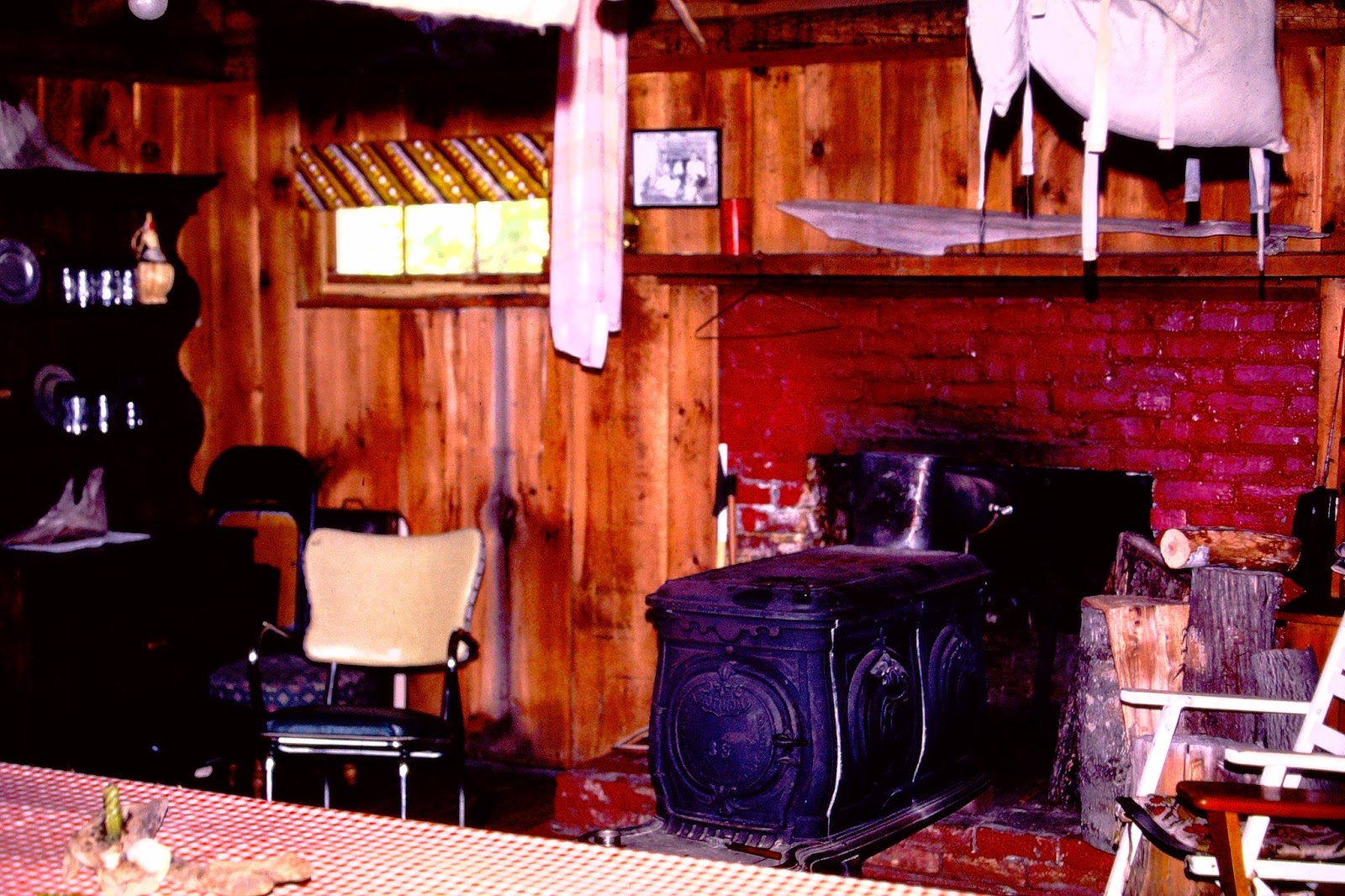
 Kitchen, every thing cleaned up and stacked to keep mice away.
 Stove.
I didn't take many pictures inside.
I think I felt I was intruding. Although I was there with permission, I guess I felt I shouldn't take too many inside.
 Wife walking outside when we visited a few years ago. We did not get to go inside on this trip.


  In the above mentioned post I wrote about his friends who would visit and they called themselves 'Jakes Rangers' after artist, who was one of them, Maurice 'Jake' Day.

In the field just out of view in the above photo, there were several smaller cabins, log and otherwise.

Each "member" of Jake's Rangers had there own cabin to sleep in using Smiths house as the informal meeting place for there northern adventures.

Here is a picture of Jakes Rangers with Chief Justice Douglas and the caption that the Baxter State Park page had on the photo;
Jake's Rangers" at Roaring Brook, photo taken by Roaring Brook Ranger Ed Werler, date unknown (likely late 1950's,early '60's).
Left to right: Ed Pierce, Jake Day, Bentley Glidden, Justice William O' Douglas, Edmund Ware Smith. Justice Douglas was a wilderness champion and Edmund Ware Smith wrote about "Jake's Rangers" in his much loved books. Jake Day is the Maine artist who created the seal/logo for Baxter State Park.


Monday, March 5, 2018

B2R by the fire - 'The Hearts of Men' - by Nickolas Butler

I am not going to tell you this is a happy read.
Although not sad either.

But if you have been involved in Scouts or summer camps I think you will find this worth your while to pick up and read.

It explores many timely topics; moral codes, Boy Scouting, our over tech - ed world, bounderys and such.
Maybe even what it takes to be a man in our new world.

I enjoyed it enough that I ordered a copy for me cabin bookshelf.

Saturday, January 13, 2018

B2R by the fire - Braving it by James Campbell

James take us on three adventures to the Alaskan wilds with his 15 year old daughter.

As a dad who is always planning 'adventures' with my daughter, I loved the book.

Very well written and open.
We got to see one person, the daughter open up to the wilderness experience while watching the dad realize his big adventure days are coming to an end.
So he makes the best out of his time with his kid.

A very good read.

Thursday, December 14, 2017

B2R by the fireplace - A Log Cabin Christmas.

While I can't say I have read this one yet ( my wife just got it for me ) I am looking forward to a little light reading during the Christmas Holiday and shoulder surgery recovery.

I will let you know what I think of it when I am done.

Friday, December 1, 2017

B2R by the fire side. 'Canoeing with the Cree' - by Eric Sevareid

 Eric Sevareid is remembered mostly as a war correspondent and news journalist working from before WW2 till the 1980's.

But in his youth, in 1930, Sevareid and friend Walter Port travelled 2,250 miles from Minneapolis Minn. to York Factory on the Hudson Bay.

The trip took four months.

With no radio, motor or good maps the boys roughed bad weather, rapids and tough conditions to complete their journey as winter neared.

Since that took place 75 years ago, several people have taken it upon themselves to retrace the trip.

One of the books considered a classic in its area of appeal.

Monday, October 23, 2017

Deutsch Country Days! - get comfortable, a long post. Log Cabin Heaven

 If you love log cabins, how can you go wrong with a place that has a ticket booth made out of logs!
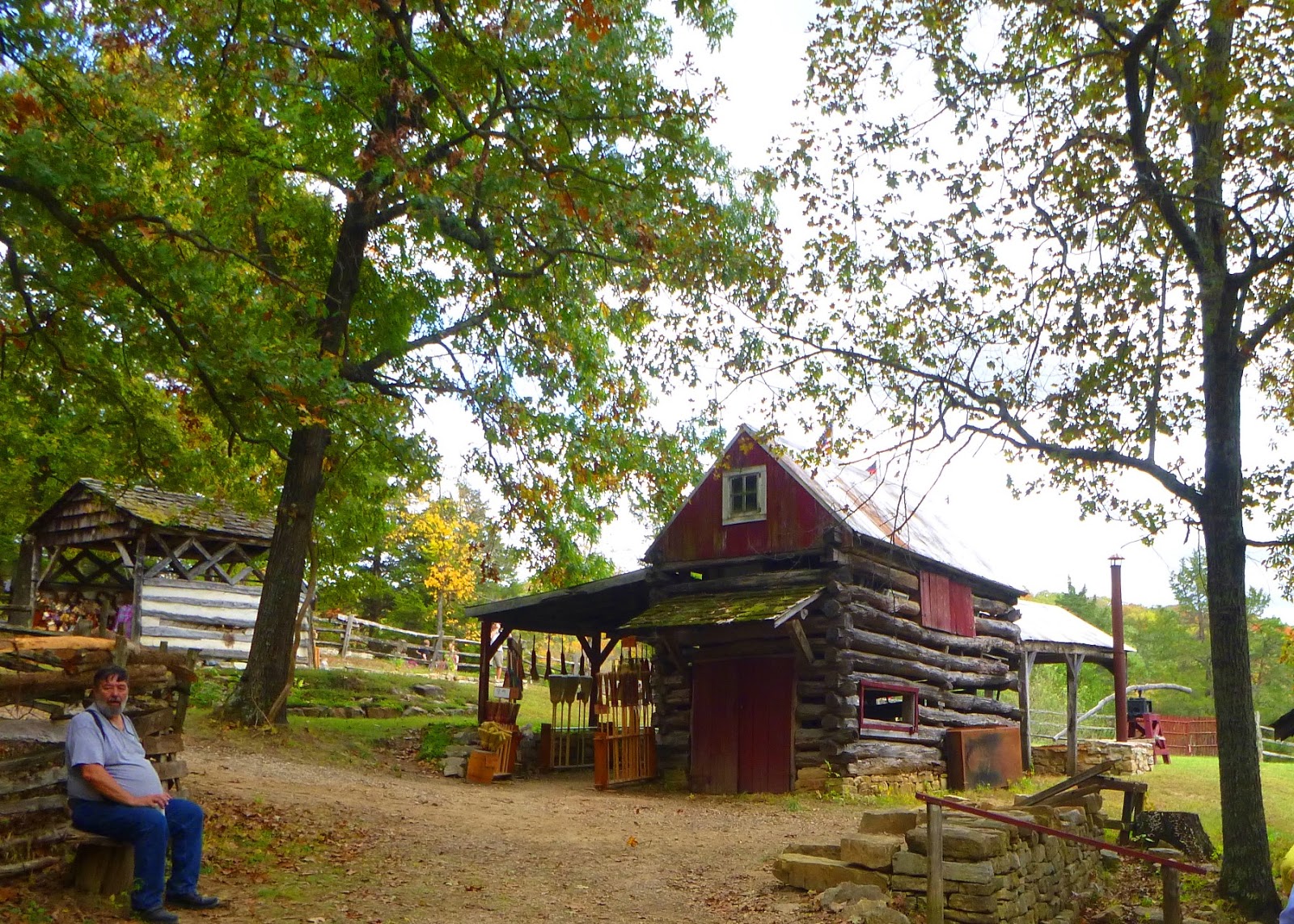
 This is the first thing you see when you enter Deutsch Country Days in Marthasville Mo. Third weekend in Oct.
Bob and Lois Hostkoetter started here in about 1979 and over the years have added over 20 rustic cabins and buildings.

Most are not being used in their original function now, but have taken on a unique purpose of once a year becoming a living folk life festival.

 I am not going to comment on each building, but rather just let you enjoy with an occasional reference.


 A nice lady here was making baskets, and my daughter jumped in and helped her for about an hour and a half.
 Basket lady and daughter sitting down.


 Live farm animals.
 Apple cider.
 Almost all the buildings were being used for something to do with our pioneer heritage.
While the 'Days' was celebration of all things from our heritage, it had a key focus on the areas German heritage.

You get the finally the 'village' has been setup with a German Alpine feel.
The main house and the one that started it all, The Huber House.
There were about 30 Huber's there on Saturday to see the old family home which had been moved from Perryville Mo.


 Bob, loved (and met) Eric Sloane, and his first build was a covered bridge he dedicated to Eric Sloane.

So as you walk around the property you can see Eric's influence on a lot of the buildings, like this little shed.

Beside just log cabins, Bob and I share the same log cabin mentor in John Frank.
While Bob is a little older than I, we started about the same time in our love for these old buildings.


 The Huber House.

 The Huber House.
 Again.
To get a feel for the lay out.
 Also for the festival they have set up what is called 'The Osage Trail'.
This is a short walk dedicated to the early Native Americans and early settlers.

The next few images are of the short hike.


 My assistant in the trappers cabin.
 Now back to the main village.


 The 'Osage Trail'.


 You don't have to even like guns, but it would be hard not to appreciate the craftsmanship of the old guns on display.

 Peddle lafte.
Early wood working tools.


 There was even a guy who made doll houses, mailboxes and bird houses looking like log cabins.


 My assistant really loved this log school house.