Tuesday, April 17, 2018

Mobile Homes? - Why move an old cabin and the use of Carpenters Marks.

  While reading an old house blog yesterday I came across an article on Carpenters Marks, like those pictured to the left.
  Most things you read about Carpenters Marks are a reference to how they were used in the construction of post and beam or timber frame construction. How these building were pieced together before they were ever assembled on site and marked so they could be reassembled on location.
  I have a different story on Carpenters Marks and how they were used.


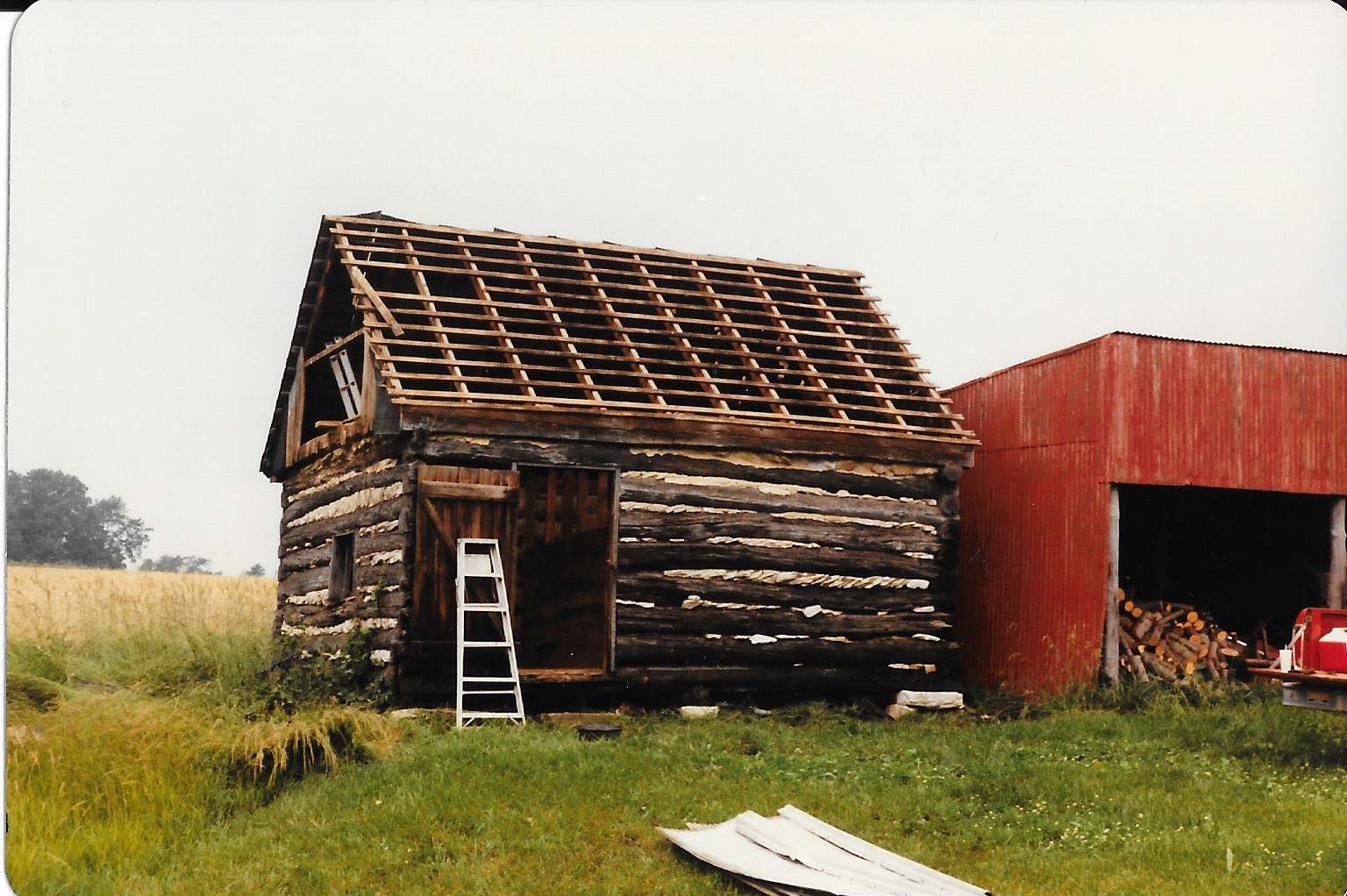
 When taking down this cabin, which would become our main cabin, as I was removing the rafters I noticed Carpenter Marks on the top plates, the logs slightly cantilevered out for the rafters to sit on.

  This brought to mind a discussion I had had with the farmer who sold me the cabin.
  As I worked on the cabin one day he told me a story; he said, "In about 1960 two old ladies in their 80's stopped by to see the old place (this cabin). While talking they said they had grown up in that cabin. Then they said, 'Did you know, although we grew up in that cabin, it wasn't on the spot it is on now.' They pointed out across the field to the east and said, 'We grew up in it, but it was moved from over on the other side of the field.'"
  (This story is also how I started dating the cabin; If they were in their 80's in 1960 that would make the age of the cabin at least 1880.)

  This story brought to mind why Carpenters Marks were used in perhaps a different way on log cabins than they were used on timber frame construction; To mark rafters to be placed back where they came from after the cabin was moved at an earlier date.

  Building methods are different from timber frame and log cabins. Tools are the same; adz, axe, maybe chisel and saw. Skills required were the same; How to use the adz and axe to fell and hew logs.
  But construction was very different.
  Timber frame most times required a large group of people to construct and raise a building, usually barns.
  Hewn log cabins were often built by just a few people with maybe and oxen, mule or horse. Sometimes it would be just the family raising the building, hopefully with strong sons and/or a horse.
If you were very lucky, you maybe had some neighbors not to far away.

  In construction, as mentioned, timber frames would be fitted together like puzzles, numbered, taken apart and rebuilt on site.

  Hewn log buildings were constructed very near where the logs were harvested and each log moved into place one at a time with no pre-build some where else. Each log stacked one at a time, with the building growing as each new log was added. Each log individually cut, hewn, notched, then places with maybe even some adjustments once it was on the wall.
   And while you will find most hewn log cabins pretty level, they perhaps were not quite as perfect as a precontructed timber frame.
  What this would mean was that once the builders got to the rafters each one could be just a little off from it's neighbor in length.
  There was no need for Carpenters Marks as you constructed a hewn log cabin, only if you had to move it at some time.

  In many cases, because of additional land purchases, or a better location decide on, a hewn cabin may at one time have been moved.
  If you were not moving a great distance, it would be far easier to move your existing cabin than to start over and make a new one. They probably had no siding attached. Mine had no outside chimney, so no fireplace. Things weren't screwed or nailed together. Pegs could be easily cut and remade for window and door frames.
  And it would be much easier to move an original cabin than it would be to move one now that has been rebuilt.
  Logs were not attached to foundations or floors as modern codes require. Usually just built right on to of a stone foundation.
  There was no electrical wiring or plumbing running through the logs that had to be removed or worked around.
  The chinking was not cement or synthetic material attached to wire mesh.
  In the original builds the chinking was just mud and binding material (grass, horse hair) stuffed between the logs. So when removing an old building in, well, the old days, the chinking would just fall out as you lifted the logs. And once you rebuilt it on another site, it was easy to re-chink the logs with home grown materials again.

  However, because of the irregular nature of a hewn log cabin build and the not quite perfectly level nature of the material the rafters would have to go back in the same spot that they came from. That is why I found the Carpenters Marks on the top plates and the rafter logs. This way the rafters could be reused in the same spots and keep the roof line true.

  I found no carpenters marks on any other point of the construction. None in the logs themselves. They may have moved them one at a time so no number system was required or they may have had some form of tagging like we do now.

  So next time you hear about carpenters marks (you know, like when you are sitting around the bar or somethin') you can add another take on the conversation.

  Just like everything else in history, one story may not be the only story.

Barnwood Builders - what I love about this show!

  My wife said it best; "That show is porn for guys like you."

  What's not to love about it?
  A great group of guys, doing something they love (don't we all wish we had jobs like that?), in beautiful areas, saving our history and having fun doing it.

  But besides all that, the thing I love most about it is all the memories and shared experiences I have in common with the show.

  These last couple of days I have been re-watching a couple of my favorite episodes.

  Yesterday I re-watched the one that took place in my home state of Missouri.
  One of the cabins featured in the show had been one I had stopped by to see just before the episode originally aired, not knowing it was going to be on the show.
  Mark and I came away with just about the same feelings about the little cabin.

  I recognize the feeling of discovery Mark experiences the first time he sees a new barn or cabin. I to have lovingly passed my hands over logs knowing the skill it took to do the work.
Or the thrill of finding great logs under really bad siding, not knowing for sure what you will get until you have it all uncovered.

  Each time I watch an episode memories of working with the old logs come back; smells, the dust, old paint, making discoveries, finding coins or marbles (even found cat bones behind a wall once).

  Another one I recently watched had the boys having to use ropes to lower logs because the ground was too wet to get their big equipment in.
  Flash back for me; coming up with a way to lower eight hundred pound logs by myself with ropes.
While our methods differed a little, the applied principles were the same and we both got the job done.

  While I will never have all the expertise that Mark and his crew have, I am often pleased with some of the 'ah-ha' moments I have when watching Mark explain something I had discovered also.

  In some episodes I watch Sherman make a notch, and am pleased with how well mine have turned out.

  Most of those guys probably learned most of what they know from hands-on experience. My skills with cabins were learned very much the same way. When comparing what they do with what I have done I am pretty proud of having gained many of the same skills and much of the same knowledge.

  Like most TV shows I like, this one will eventually come to an end long before I want it to. But I am sure enjoying it while I can.


Monday, April 16, 2018

Time out at the cabin this weekend. Worked on the treehouse and spring cleaning.

Spring has sprung out at the cabin.
Although with snow on and off all weekend (flurries), someone did not get the memo.

Wildflowers and non-natives were coming up. As were the May Apples.
In this photo you can see the main cabin and the two latest projects.
While I did spring cleaning all of Sunday. . . .


. . .  all of Saturday I worked on getting bunks in the tree house.

While the top one is slightly shorter than the bottom one (window considerations) both are long enough for an adult.

Friday, April 6, 2018

Little cabin in the (downed) woods or 'as memory serves'

Our memories are funny things.
Things are smaller than we remember.
Things aren't always where we thought they were.
Many years ago, 30 plus, my log cabin mentor, John Frank, took me by a little log cabin in OFallon Mo.
  I am sure we had been out doing other things that day also; cutting firewood, visiting other antique shops, etc. And we stopped by a little log cabin near a much newer brick home. I don't know the reason we stopped by. Maybe they wanted his advice on something to do with it. Maybe they thought he would want to take it down and move it.
I just don't remember the purpose of our visit.

 On the way out to our cabin, we would pass where I seemed to remember this little cabin stood, just out of sight from the road.
  And for these last thirteen years or so I often drive by the spot in my work truck usually couple of times a week.
  But being in a work truck, I don't stop by. "I'll do it another day," had become my excuse.

  Well, driving by the site yesterday, I noticed a lot of brush and trees had been removed, land cleared and a 'for sale' sign on the lot.
  Well, I have missed a few chances at others times, to look at an old building, just to find them gone when I finally get there, so I thought I better make it happen.


  The top picture is how I found it yesterday. Hidden in the bulldozed trees. It sat just below the levee of a small pond.

  They had made sure all the trees were kept clear of the building (and the others on the site).

 This is the front door and porch.

  The door is missing, as is the window on this side.

  Not much left of the porch decking, but what was there was stable.


  Inside was a half loft, with an old wood ladder going up.

  The loft joist's were left round and still had bark on them, as did the rafters.

The loft floor was rough cut boards.
  This is the view as you walk in the front door.
  Not to much rubble really.

Fireplace to the right.
An old chest of drawers tipped over.

Not much else.

At one time it was wired for electric.

 The chinking is a little over done, especially on the inside.

But that happens quite often.

 I love the little shelves around the room. The supports were cut to shape to fit around the logs.

A nice little detail.
 This is the addition on the back, or west side.

  Sun was just in the wrong place to get a good shot of it.

  I don't know if it was used as a kitchen or just another room.

  There was an overturned couch in it when I stopped by.
 The gable ends are covered with rough cut boards.

  You can see right through the gaps, so it had never had insulation of any kind. At least at this location.


The roof is old channel and grove tin.

 The notches are 'V' notches, and the logs have been hewn.

  They are very small logs, so this could have been some type of utility building or even a slave or workers cabin at one time.

  This, the south side, had the most weather and possible damage.

  I doubt if the window is original.
The style and shape do not indicate that.

  Probably added later or during a move of the cabin at one time.

  If the logs did not prove to be in to bad a shape it would be a fun little building to reuse as a play house, shed or little weekend place.

Thursday, April 5, 2018

B2R by the fire, Kids addition - Mardy Murie Did

I have been interested in the work done by Mardy and Olaus Murie ever since John Denver did a song about them.

Pioneer conservationists for Alaska and the rest of the U.S.

This wonderful little children's book is wonderfully illustrated and gives a very small introductory view into the life of Mardy Murie.

And it has log cabins in it.


How fortunate we are. . . . .

How fortunate we are. . .
  That we can now look back on old log buildings as symbols of the pioneer spirit and craftsmanship.
  We look on them with a nostolgic feeling.
  Many of us can now afford to rebuild and restore many old log buildings as fun hobbies and weekend homes. Others can afford the price of turning them into modern homes.
And while all this is well and good, and are things we should observe about old buildings in general, for many people they were a symbol of something else.


  This month my daughters fifth grade class will start studying Plantation life and slavery.
  The first log cabin  I acquired for my own use I was told was an old slaves cabin.
  Over the years it had been used for many things since it's time as a home for slaves, even as a grain bin.
  I don't know for a fact that it had actually been used as a slaves home, but that is what I was told.
  It had many of the signs of a  slaves home, small windows and doors. Roughly built. Small. It could have been.

  We honor white men who came from a log cabin background and made more of themselves, Abe Lincoln, U. S. Grant, Andrew Jackson.
  And many of our frontier hero's started out in cabins or lived in them; Davie Crockett, Daniel Boone.

  But for others, they could have been a symbol of oppression, never having the chance to move onto something better. The Slave.
  While not all slave homes were built log cabin style, I would imagine a great many were, along with rough clap board siding or brick.
  Slaves on larger plantations probably had slightly better built homes (especially if it reflected on the wealth of the owner) than the slave who lived on smaller less profitable farms.

I have posted on this blog several times images of slaves cabins.

 These next two images are of a restored slaves cabin not to far from our place.


Today I thought I would add just a couple images of other slave cabins in Missouri. I have not seen any of these, and most probably no longer stand.

 Most of us who love these old buildings and want to save them can look beyond how they look when we start taking them down. We can in our minds imagine how they will look when we are finished, using our modern tools with the latest materials.

But for the people who lived in them, they would probably never be much more the the rough structure we see in the photos.
 They would never have the fine antiques we may put in them.
They may never have the efficient stove or fireplace we light on chilly nights.

Their floors may always have to be dirt.
And it would probably not be past on to their children.
Eight to ten people may have to live in one small cabin.

Probably no beds, at least for the children.

They probably spent as little time as possible inside.

Again, while slaves may not have been the only ones to start out in this hard scrabble life, they did not have the chance to make their situation better.


When I took this one down I did not own a piece of land to put it on.
I had to take the cabin if I wanted the old blue cook stove that I had gone to this farm to buy.

By the time I got land and had the money to rebuild a cabin the logs were no longer any good.

I wish I could change that.