
Thursday, September 15, 2016

Wednesday, September 14, 2016


Paintings with Log Cabins - Hal Foster
Hal Foster is just one of my favorite artists period. And like many artists because of his chosen field he is often over looked.
Most people know Hal's work from his comic strip Prince Valiant (1937) and his work on the strip Tarzan (1928). Born in Nova Scotia in 1892. Much of his youth was spent exploring the outdoors.
He also worked as staff artist for the Hudson Bay Company for a while. In 1919 he rode his bike to Chicago to study art and soon found work as an illustrator.
While known mostly for his comic work soon of his early illustration work centered around life north of the U.S. border.
One of the first illustration I came across of his was an image of what a canoe portage was like.
 If you have ever done any kind of canoe portaging you can understand this illustration.
Now imagine doing it with gear not as light weight as modern gear.
A lot of his early works were illustrations for stories about the Mounties. And looking at one of his early works about the Mounties I came across one the had a couple of log cabins in it.

While images of Hal's other works are limited, there are a couple good books out there on his life offering a look into his early life.
 A young Hal Foster with a Mountie painting in the background.
Most people know Hal's work from his comic strip Prince Valiant (1937) and his work on the strip Tarzan (1928). Born in Nova Scotia in 1892. Much of his youth was spent exploring the outdoors.
He also worked as staff artist for the Hudson Bay Company for a while. In 1919 he rode his bike to Chicago to study art and soon found work as an illustrator.
While known mostly for his comic work soon of his early illustration work centered around life north of the U.S. border.
One of the first illustration I came across of his was an image of what a canoe portage was like.

Now imagine doing it with gear not as light weight as modern gear.
A lot of his early works were illustrations for stories about the Mounties. And looking at one of his early works about the Mounties I came across one the had a couple of log cabins in it.

While images of Hal's other works are limited, there are a couple good books out there on his life offering a look into his early life.

Friday, September 9, 2016

Wednesday, September 7, 2016
I love this image. . .

I love this image! Log house and log barn.
Imagine if you will the house in the back ground covered in white clap-board siding.
And then think about some of your rural drives where you saw house like that.
They could have had log cabins under that siding.
It is hard to tell if the barn in the foreground is a two pen barn or just has a wide front door.
Notice the two people who seem to be seated in a buggy or wagon. Probably pretty proud of that wagon.
The slit rail fence, and a board fence.
What a great image.
Tuesday, September 6, 2016

Got time this Labor day weekend to labor on the Adirondack lean-to project.


Hot weather and daughter sports kept me from working on it all summer. Darn.
But this weekend allowed me time to start up again.
Here you can see the third log placed and ready to be notched.

The first notch on most sill logs for some reason is just this simple diagonal sill notch. The next log on top of that will have a matching notch. After the base logs (sill), builders would use either a 'V' notch or some sort of dovetail.
Occasionally a flat notch. or rounded 'saddle' notch on softer woods.
Axe, chisel, chainsaw and hammer were the tools for the day.

On this one you can still see the tag from my numbering system when I first took this old log building down over twenty years ago.
This notch is a 'V' notch, but not in very good shape with the ends damaged.

Look how good the wood is on the inside after being down for over one hundred and fifty years.


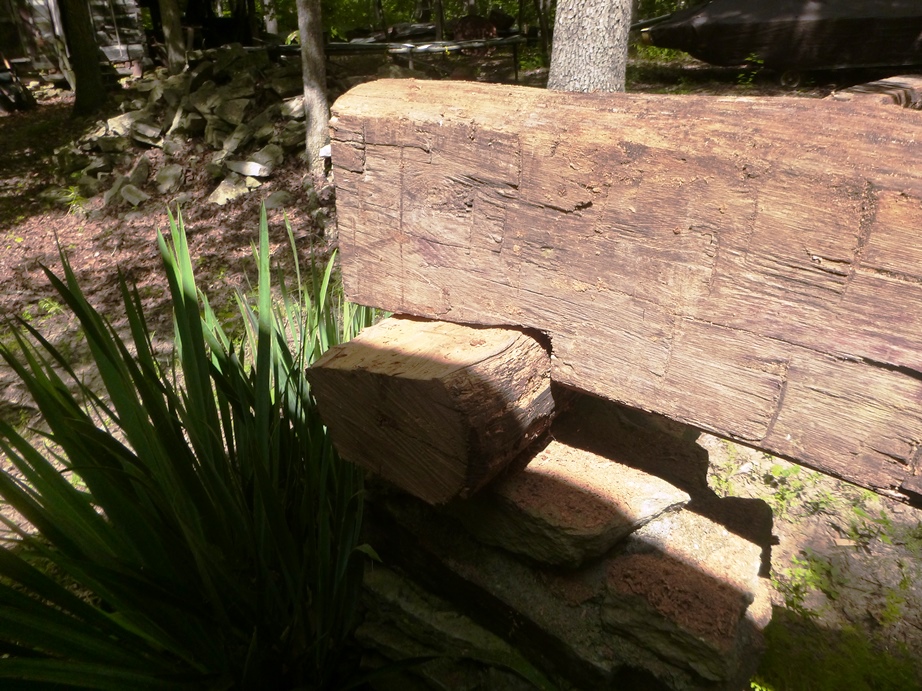


On this one you can see the old Adz and axe marks. And my numbering tag.


This longer log at the back will start the next course.
Its purpose in the cabin I took down was one of the two logs supporting the second story floor joists.

Now I have to make sure that stays true after I notch it.


When working on the big house I had an old tractor to help me move the logs around the lot.
Still, sometimes the logs had to be moved into place by hand to places the tractor could not get.
No tractor this time so, . . .with a good hauling rope. . .

Just don't get in the way once they start to move.
Getting them up on the foundation still requires effort and ramps.
I will keep you posted on the project as fall moves along.
Subscribe to:
Posts (Atom)