
Wednesday, January 7, 2015

Tuesday, January 6, 2015
New Year's Day plus 3 drive. . . a couple new log buildings.

When I arrived it was about 25 degrees outside, and dropping.


Thermostat reads 30 degrees inside when I started the fire.
After I got a good fire going I headed out for a drive to find old buildings.

Very old, and although I didn't explore any closer without permission, the half of the house on the right is not log, but I do not know about the other half.
Probably the summer kitchen seen at the back.
Just out of view on the left of this picture, across the drive-way. . .

Looking as though it has been used as a barn or storage building for a while. . .

Barns would not have had such nice doors or such nicely hewn logs.

The log work joining the two halves of the building is wonderful.
You don't often see logs joined so well.
The second room, to the left, was probably added later with the fine wood joins and notching.
Because of the size of the trees in our area it would not have been necessary to join short logs together to make two rooms. A log long enough to make up the length of this side would not have been hard to come by.
Another reason the two rooms could have been built with hewn logs splitting the interior was the lack of milled lumber to build interior walls at the time this one was built.

Whether it was a full second story or just a half story I can not tell without closer exploration, which this building does not tend to offer.
My guess is the current (now fallen in) roof pitch is not original, and that the original roof rafters would have been made of of unmilled logs.
The building could have been the original home on the site or a workers or slave cabin.
The door is very nice.
This is the west end.

Note the old six-over-six windows.
(click any picture to enlarge.)

Never a large town, only a few well kept buildings remain.
One time stores still sell antiques.
All wonderfully tin-sided.

I have watched this building for years, at one time looking at it when it was for sale.
Although not much has been done to it, the new owners are keeping it up and slowly re-doing it.
When I looked at it years ago the cellar was about chest deep with water.
At the back they are working on re-tucking the bricks.


My purpose for visiting Holstein was to once again photograph an old store in town. It was (was, because it is no longer there) a typical small town store front covered in tin siding. Built I believe around 1907.
Although that building no longer stands, Holstein still has many fine old building.
This one probably an old garage or work shop.


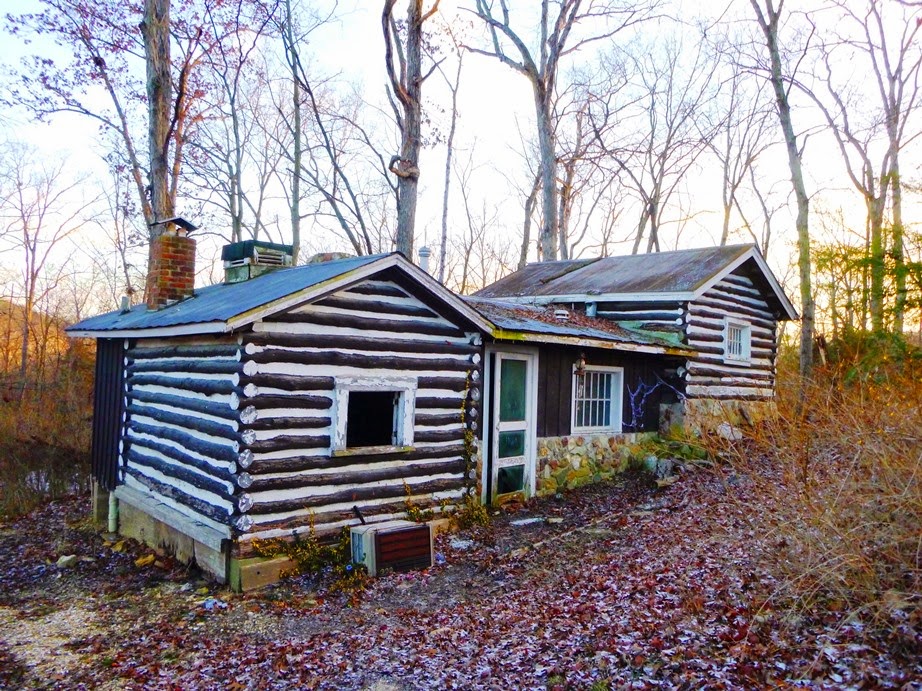


It had gotten up to about 34 degrees inside while I was gone.
But then again, it had dropped to 15 degrees outside.
Wednesday, December 24, 2014

Wednesday, December 10, 2014
W. Ben Hunt's cabin
If you grow up in the 60's and were in Boy Scouts you probably remember much of his works.
W. Ben Hunt

W. Ben Hunt
Monday, December 8, 2014
Not log, but related to the last post. . . .The Lost Valley Lodge
Many years ago, before 1940, there use to be three tiny villages in St Charles County Mo., Howell, Hamburg and Toonerville.
Then Hitler tried to take over Europe and Japan ran amok in the Pacific.
And TNT was needed for the war effort and a location close to St Louis was needed that also had access to rail lines and roads.
The property was found just across the Missouri River from St Louis County.
But three tiny villages stood in the way.
But what the government needed, wasn't to be denied.
Smarter people than I have argued the waste in the destruction. And I am sure people in the government could argue that it was necessary.
The were many families displaced, and homes lost and businesses closed down. Communities that most people in St Charles County now aren't even aware existed. Some of the homes were small and simple. Many large and would now be considered historical. Many log structures were lost.
The whole story of the area can be found here, The TNT Story.
For all the destruction of homes, there was some good to come out of it. To the people that lost their homes, I am sure it is not enough.
I am one of the many people who have benefited from the TNT Story. Although it must be said I would have loved to have seen these old buildings.
Once the War Department was done with the property much of it was sold to the University of Missouri as a research area for agriculture. And in the end, it all ended up in the hands of the very capable Missouri Conservation Dept. Thankfully private developers never had the chance to acquire this wonderful land.
While the University owned the property the local St. Charles County Boy Scouts were able to use much of the land for camp sites and activities. This is how I came to know the area.
Our troop spent many weekends camping in the area. And later on I would hike and explore most of the area that was once these villages.
On the property the scouts were able to use the beautiful old building we called 'The Lodge'.
Large and built of stone, for most of the year it was home to the man who looked after the area for the scouts. His job was to mow and generally keep the place up for camping and hiking. Over the years he spent a lot of his own money making the place better by building camping shelters and keeping the swimming hole deep and usable. (It included a long wood bridge with a great swinging rope.)
I knew little about the history of the building other than we were told it was officers quarters when the army owned the property. It is with reading the TNT Story that I found the rest of the history.
In 1980 I did a painting of the old lodge. It was soon to be torn down. A few of us tried to save it, but it was not meant to be. It would have been almost 80 years old now.
I first started experiencing the place in about 1965. It would have only been about 26 years old by then.
Here is the painting I did just a few years before it came down.


.jpg) "The home was nearly new in 1940. . " So the TNT Story goes. It was built by an executive for Brown Shoe Company of St Louis. The original owner was a William Kaut.
"The home was nearly new in 1940. . " So the TNT Story goes. It was built by an executive for Brown Shoe Company of St Louis. The original owner was a William Kaut.
The above photo is the same view as the painting, approximately.
Imagine having this almost new home taken away from you for what the government thought was needed.
This next photo is a back and side view, also showing in the foreground the pump house. A really good view of the high center ceiling.


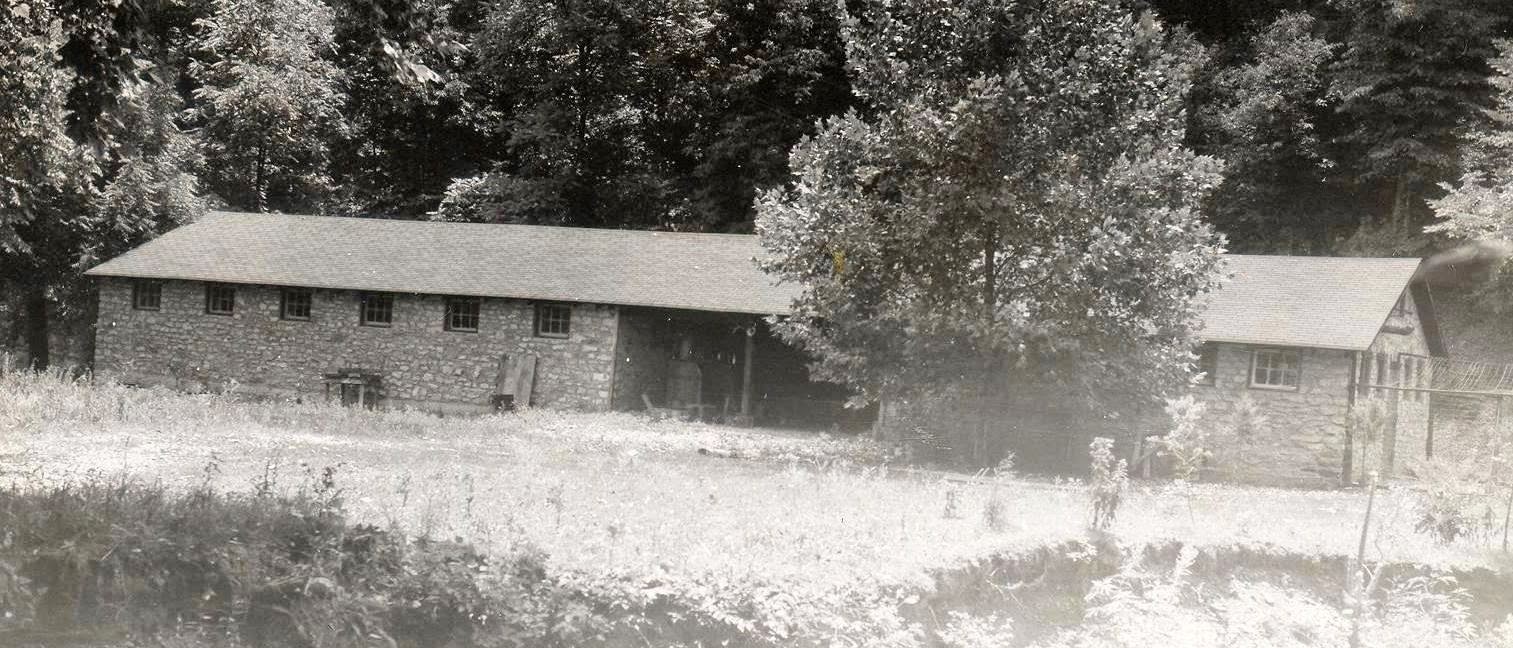
 The next photo is of the long building which was a barn and stable. In our scouting days it was a bunk house and workshop. It was across the creek near the swimming hole.

Then Hitler tried to take over Europe and Japan ran amok in the Pacific.
And TNT was needed for the war effort and a location close to St Louis was needed that also had access to rail lines and roads.
The property was found just across the Missouri River from St Louis County.
But three tiny villages stood in the way.
But what the government needed, wasn't to be denied.
Smarter people than I have argued the waste in the destruction. And I am sure people in the government could argue that it was necessary.
The were many families displaced, and homes lost and businesses closed down. Communities that most people in St Charles County now aren't even aware existed. Some of the homes were small and simple. Many large and would now be considered historical. Many log structures were lost.
The whole story of the area can be found here, The TNT Story.
For all the destruction of homes, there was some good to come out of it. To the people that lost their homes, I am sure it is not enough.
I am one of the many people who have benefited from the TNT Story. Although it must be said I would have loved to have seen these old buildings.
Once the War Department was done with the property much of it was sold to the University of Missouri as a research area for agriculture. And in the end, it all ended up in the hands of the very capable Missouri Conservation Dept. Thankfully private developers never had the chance to acquire this wonderful land.
While the University owned the property the local St. Charles County Boy Scouts were able to use much of the land for camp sites and activities. This is how I came to know the area.
Our troop spent many weekends camping in the area. And later on I would hike and explore most of the area that was once these villages.
On the property the scouts were able to use the beautiful old building we called 'The Lodge'.
Large and built of stone, for most of the year it was home to the man who looked after the area for the scouts. His job was to mow and generally keep the place up for camping and hiking. Over the years he spent a lot of his own money making the place better by building camping shelters and keeping the swimming hole deep and usable. (It included a long wood bridge with a great swinging rope.)
I knew little about the history of the building other than we were told it was officers quarters when the army owned the property. It is with reading the TNT Story that I found the rest of the history.
In 1980 I did a painting of the old lodge. It was soon to be torn down. A few of us tried to save it, but it was not meant to be. It would have been almost 80 years old now.
I first started experiencing the place in about 1965. It would have only been about 26 years old by then.
Here is the painting I did just a few years before it came down.
Although it mostly served as the residence of the caretaker, it also had two bunk rooms that each slept about eight boys (and many times Girl Scouts also). The three windows on the left would have been the front bunk room. The three to the right of the front door would have been the caretakers work shop.
The center room where the raised roof is was a large main living room with a very large fire place. The ceiling was so high (How high was it?) that during winter outings at the lodge we could set a trampoline up inside.
Another bunk room was also on the left, but at the back of the building.
This small building at the left in the painting was the water pump house and shower.
This next building on the right in the painting was a summer sleeping porch that the caretaker built above the old stone cellar and gas shed.
When I stayed down and helped the caretaker for a week or so one summer I slept in the summer porch. And to show how things stick in ones mind; It was the week Louis Armstrong died in 1971.
(I know where I was when Elvis and JFK died also.)
Us unknowing Scouts always believed the place was built for officers involved with the TNT plant. Although we were wrong, it was partly true.
These following wonderful photos are from the TNT Story of how the place looked before the government got it, and a little about the history of it.
The above photo is the same view as the painting, approximately.
Imagine having this almost new home taken away from you for what the government thought was needed.
This next photo is a back and side view, also showing in the foreground the pump house. A really good view of the high center ceiling.
The next picture is the cave like cellar that the summer sleeping porch was built above.
Also on the property was this caretakers house, which we used as a bunk house for the scouts . .
Here is what the Kaut's said of the place when trying not to lose it: "In testimony in United States Circuit Court in 1942, William
Kaut described this property as follows: "[It was] a park, not a
farm. We worked that [acreage] for seven years to put it in shape.
The residence was a ranch type house of logs, ten rooms, air-conditioned, had
three baths, very fine baths; lavatory and toilet off the game room; slab floor
all . . . a ten-room house. Also a barn one hundred feet long and
twenty-seven feet wide. It was all rock. The water-works there was
also a rock building, with built-in laundry and shower, and also an underground
room 14 by 16 for storage, with a two thousand gallon oil tank and filling station
and water pipe."
Although the buildings survived the war, and served as an Officers Club (which seems really unfair to me). . . .
It was eventually taken down in the early 80's when the Missouri Conservation Dept. took over the property.
Very little of the land lost in these three villages was actually used by the War Dept.
The TNT plant, although large was never to near many of the buildings. I guess they government wanted a large secure zone around the plants.
I tried to find a purpose for the building for the conservation Dept. but they thought the need and expense made it impossible. I disagree.
149 families were moved. That plant did not even last till the end of the war, closing in Jan. 1944.
Many of the people who lost their homes were paid very little, and some took a long time to be paid.
Go to the site TNT Story and look at the homes and villages lost. It is sad.
Although lost to these families it was a great benefit for many years to local Boy Scouts. And it now serves as protected land for wildlife and nature. So, you see, it's not all bad news.
But still, was it necessary.
Additional comments from the buy out;
Large payments to individual landowners included $42,288 to Mr. and Mrs. William Kaut for their 74 acres, assessed at $5000. Kaut is general superintendent for the Brown Shoe Company. Kaut, who was ill yesterday, could not comment but his son, William Kaut Jr., said there were extensive improvements on the grounds including a nine-room stone house with four baths.
And;
Quickly Agrees TNT No Place for Home
Living near an explosives plant is nothing new to William Kaut, general superintendent of the Brown Shoe Company here, but he thinks so little of the idea that he was among the first to agree with the War Department option-buyers on the price at which he would yield his new St. Charles County home to the proposed TNT plant.
Built three years ago as a “home for the rest of my life,” Kaut’s 75-acre tract contains a stone 10-room residence, a barn and a cottage. The grounds have been carefully landscaped.
Twenty years ago Kaut had his first experience with powder plant explosions when he lived in Carthage, Mo. Twelve miles away was the Hercules Powder plant, which he said blew up several times without extensive near-by damage.
“While they didn’t hurt my place, I don’t have any desire to live near another explosives plant,” he said. “I have already signed an option to sell my property to the government for the St. Charles County plant. There’s no other way out of it and I believe all landowners affected would do better to work with the government on the job than against.”


Friday, December 5, 2014
Just some old photos to keep you in the right mind. . . .


HERE is a link to a pinterest site on old log cabins.
Subscribe to:
Posts (Atom)